
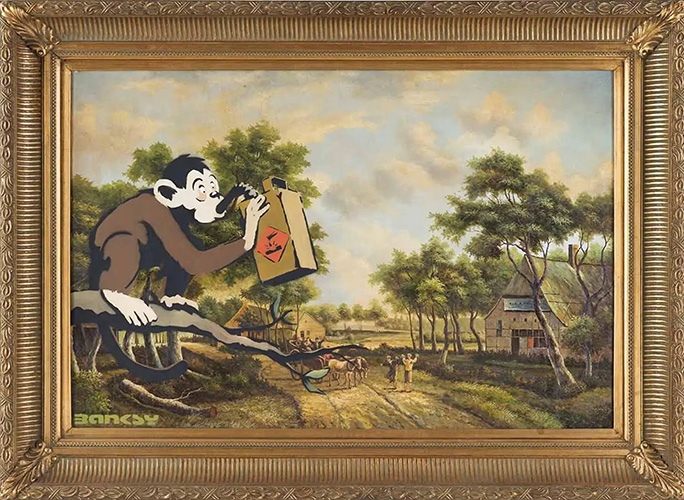
In “Monkey Poison” (2004), Banksy once again intervenes in a traditional pastoral painting, disrupting the rural idyll with a bold cartoon figure: a monkey drinking from a canister marked with a toxic symbol. The absurdity of the scene resembles a dark children’s book illustration – yet it carries a deeper message. With biting satire, Banksy critiques environmental destruction, human ignorance, and the toxic nature of modern consumption, whether chemical, media-driven, or societal. The monkey becomes a mirror of human behavior—and a warning against our own self-destructive foolishness.
In „Monkey Poison“ (2004) greift Banksy erneut in ein traditionelles pastorales Gemälde ein und durchbricht die ländliche Idylle mit einer auffälligen Comicfigur: einem Affen, der aus einem Kanister mit Giftwarnsymbol trinkt. Die Absurdität der Szene erinnert an eine düstere Illustration aus einem Kinderbuch – trägt jedoch eine tiefere Bedeutung in sich. Mit bissiger Satire kritisiert Banksy Umweltzerstörung, menschliche Ignoranz und die toxische Natur modernen Konsums – sei er chemischer, medialer oder gesellschaftlicher Art. Der Affe wird zum Spiegel menschlichen Verhaltens und zugleich zu einer Warnung vor unserer eigenen selbstzerstörerischen Dummheit.
Dans « Monkey Poison » (2004), Banksy intervient une nouvelle fois dans une peinture pastorale traditionnelle, bouleversant l’idylle rurale avec un personnage de bande dessinée incongru : un singe buvant à même un bidon marqué du symbole de toxicité. L’absurdité de la scène rappelle l’illustration d’un livre pour enfants empreinte d’humour noir, mais elle véhicule un message plus profond. Avec une satire cinglante, Banksy critique la destruction de l’environnement, l’ignorance humaine et la nature toxique de la consommation moderne, qu’elle soit chimique, médiatique ou sociétale. Le singe devient un miroir du comportement humain et un avertissement contre notre propre folie autodestructrice.
In Monkey Poison (2004) verstoort Banksy een traditioneel landelijk tafereel met een cartooneske aap die drinkt uit een jerrycan met een giftig waarschuwingssymbool. Het beeld oogt bijna speels, maar draagt een donkere boodschap. Met scherpe satire richt Banksy zijn kritiek op milieuvervuiling, menselijke achteloosheid en de schadelijke kanten van moderne consumptie. De aap fungeert als spiegel voor menselijk gedrag en als waarschuwing voor zelfdestructie.